Engineering teaches us how to solve systems.
Leadership requires us to shape thinking.
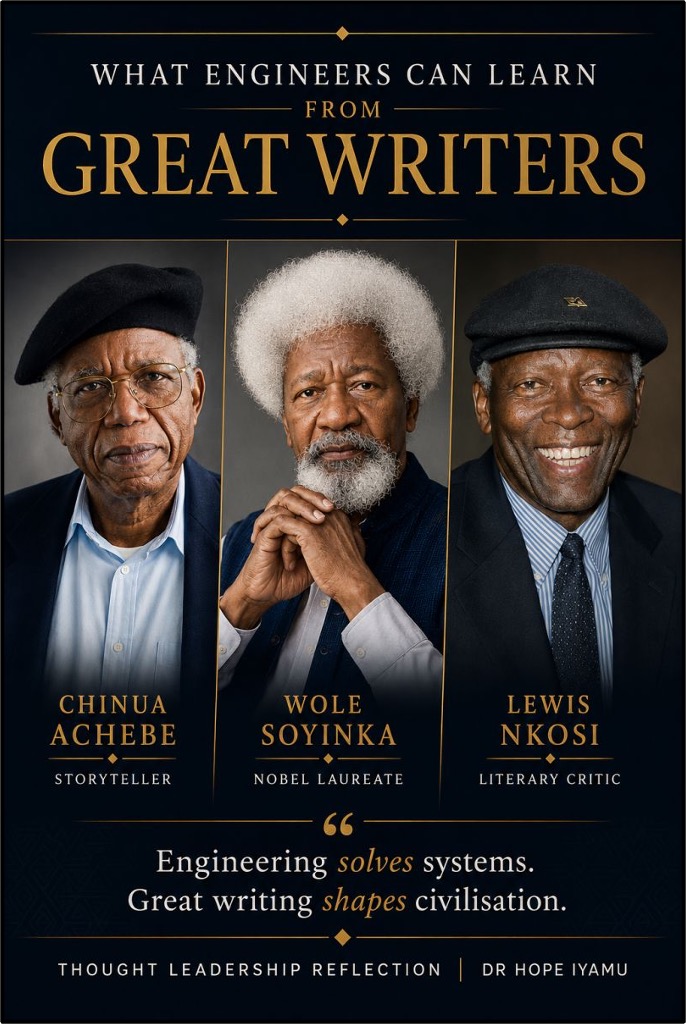
Reflecting on Chinua Achebe, Wole Soyinka, and Lewis Nkosi reminded me of something modern professional life risks losing:
Intellectual craftsmanship.
This was a generation where ideas carried weight.
Where writing was not merely produced for speed, visibility, or short attention spans, but crafted with discipline, depth, and enduring purpose.
Chinua Achebe restored dignity to African storytelling and placed African narrative consciousness firmly on the global literary map.
Wole Soyinka, the first Black African Nobel Laureate in Literature, demonstrated that African intellectual excellence belongs at the highest global table.
Lewis Nkosi brought literary sophistication, cultural critique, and intellectual sharpness that transcended borders.
These men did not merely write.
They shaped thought.
And that lesson extends far beyond literature.
Because in engineering…
in governance…
in infrastructure…
in business…
in leadership…
clarity of thought is a competitive advantage.
Technical competence can design systems.
But institutions, ideas, influence, and trust are shaped by intellectual depth and communication.
One reflection stayed with me:
Engineering solves systems. Great writing shapes civilisation.
In an age of rapid content and shrinking attention spans, thoughtful communication may be more valuable than ever.
Professional excellence is not only about what you know.
It is also about how clearly you think, how deeply you reflect, and how effectively you communicate complexity.
That principle is as true in engineering as it is in literature.
#ThoughtLeadership #EngineeringLeadership #Leadership #InfrastructureLeadership #Governance #Communication#ExecutiveLeadership
About the Author
Dr Hope Iyamu is a Civil & Environmental Engineer, educator, and reflective author. Through Lessons & Light, he shares reflections on leadership, character, governance, resilience, and purposeful living, drawing on experiences across engineering, academia, public service, and life.
LinkedIn: www.linkedin.com/in/hope-iyamu