
HCS Insights | Infrastructure Sustainability
By Dr Hope Iyamu
Western Australia is entering an important new phase in the way it manages residual municipal waste.
In July and August 2026, the Cities of Belmont, Kalamunda and Swan and the Shire of Mundaring began directing general waste to the East Rockingham Waste to Energy facility. According to the participating councils, approximately 96 per cent of waste delivered to the facility is expected to be diverted from landfill through energy recovery and the recovery of useful materials.
That is a significant infrastructure development.
But it also raises an important question:
Is a high landfill-diversion rate necessarily the same thing as a high-performing circular economy?
The answer requires more than looking at a percentage.
It requires examining what happens to waste before it reaches the facility, what happens to the materials and energy recovered from it, what residuals remain, and whether the overall system continues to move waste management upward through the waste hierarchy.
This distinction matters because landfill diversion is an important outcome, but it is not, by itself, a complete measure of circularity.
A Major Change in Perth’s Waste Infrastructure
The East Rockingham Waste to Energy facility represents one of Western Australia’s most significant investments in residual-waste infrastructure.
When fully operational, the facility is designed to process approximately 300,000 tonnes of residual waste each year and export approximately 29 MW of electricity to the grid.
The facility reached its first-fire-on-waste commissioning milestone in 2026.
For local governments traditionally reliant on landfill, the change is substantial.
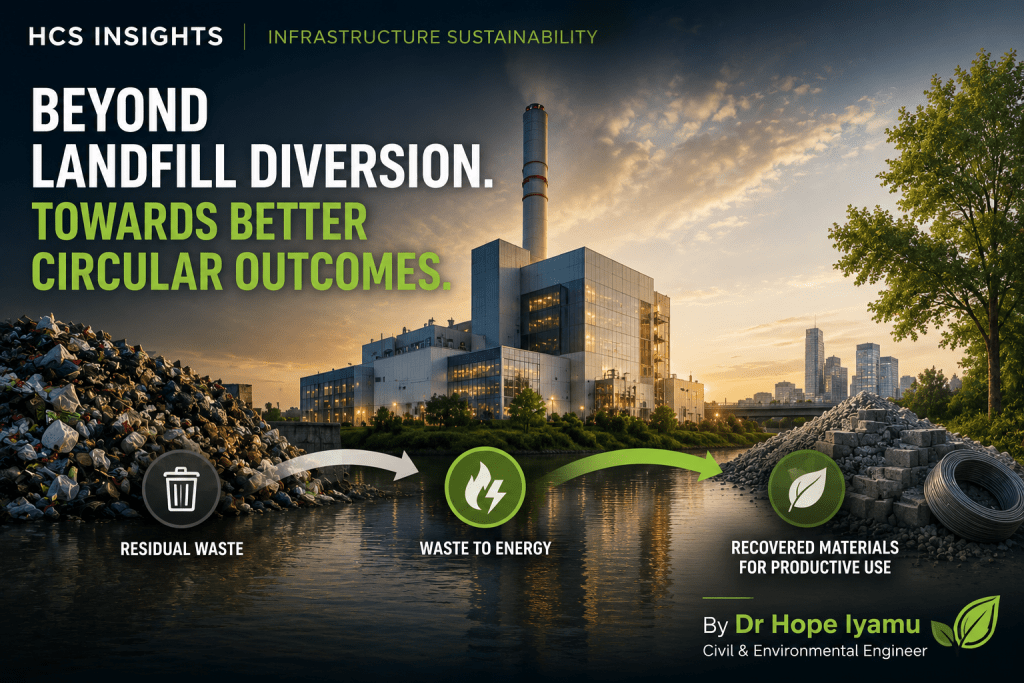
Instead of general waste being transported to landfill and permanently buried, residual waste is combusted under controlled conditions. Heat generated by the process produces steam and electricity. Metals can subsequently be recovered from bottom ash, while processed bottom ash potentially provides an aggregate for construction applications.
The participating councils report approximately 96 per cent landfill diversion for waste entering the facility.
From a landfill-management perspective, this is significant.
Less waste entering landfill can reduce pressure on increasingly constrained landfill capacity, avoid some long-term landfill liabilities and reduce methane generation associated with biodegradable materials.
There is also an increasingly important economic dimension.
Western Australia's landfill levy for metropolitan waste increased to $90 per tonne from 1 July 2026, with the published schedule indicating further increases to $93 per tonne in 2027–28, $94 in 2028–29 and $97 in 2029–30.
As landfill becomes progressively more expensive, alternative residual-waste infrastructure becomes increasingly important to the economics of municipal waste management.
But the engineering assessment cannot end there.
Landfill Diversion and Circularity Are Not the Same Measure
A tonne of material diverted from landfill can follow several very different pathways.
It might be avoided altogether.
It might be reused.
It might be repaired or refurbished.
It might be recycled into another material.
It might be processed biologically.
Or its energy content might ultimately be recovered through combustion.
All of these pathways avoid direct landfill disposal, but they do not occupy the same position within the waste hierarchy.
Western Australia's Beyond WAste 2030 framework makes this distinction clear. Avoidance, reuse and recycling sit above energy recovery, while energy recovery remains preferable to disposal.
That hierarchy reflects an important principle.
Where technically, environmentally and economically practicable, preserving the material value embodied in products and resources through higher-order recovery is generally preferable to destroying that material and recovering principally its energy value.
This does not make waste-to-energy inherently inconsistent with a circular economy.
It defines its appropriate role within one.
Energy recovery should principally manage genuinely residual waste after reasonable opportunities for avoidance, reuse, source separation and recycling have been exhausted.
That distinction is critical.
The Engineering Question Is: What Is Actually in the Residual Bin?
Waste-to-energy works most convincingly within the waste hierarchy when its feedstock is genuinely residual.
That means materials which cannot reasonably be avoided, reused, recycled or otherwise recovered through higher-order pathways.
If significant quantities of recyclable paper, cardboard, metals, plastics or recoverable organics remain in the residual stream, achieving a high landfill-diversion rate through energy recovery does not necessarily demonstrate that the waste system itself has reached its optimum performance.
The more meaningful question becomes:
How much material entering energy recovery could reasonably have remained within the productive economy through a higher-order recovery pathway?
This is why source separation remains fundamental.
FOGO collection, effective recycling systems, commercial material recovery, household education and viable markets for recovered materials remain important even when substantial waste-to-energy capacity becomes available.
Encouragingly, the East Rockingham arrangements with councils are described as “waste arising” contracts, rather than fixed minimum-tonnage commitments.
This distinction matters.
Under this approach, councils are not required to maintain a predetermined quantity of residual waste simply to feed the facility. Waste reduction, recycling and FOGO initiatives can therefore continue reducing the residual stream.
From a circular-economy perspective, this contractual flexibility is important because waste infrastructure should adapt to successful waste reduction — not depend upon preventing it.
What Happens After Combustion Also Matters
The process does not end when waste enters the furnace.
East Rockingham is expected to generate substantial quantities of bottom ash, alongside smaller quantities of flue-gas-treatment residuals.
Project information indicates that metals will be recovered from bottom ash and that the remaining processed material is intended to have potential applications as aggregate in road bases and other construction uses.
This creates another important circular-economy test:
Are there durable, technically appropriate and commercially viable markets for these recovered materials?
Producing a secondary material is only one part of resource recovery.
Someone must be able to use it.
Specifications must allow it.
Environmental performance must be demonstrated.
Markets must accept it.
Transport must remain economically reasonable.
And the recovered material should preferably substitute for virgin material rather than merely creating another stockpile requiring future management.
The same principle applies throughout the circular economy.
Recovery is not complete when a material leaves the waste facility. It is complete when that material successfully re-enters productive use.
This is particularly relevant to incinerator bottom ash aggregate.
If appropriate engineering standards, environmental safeguards and viable construction markets are established, recovered aggregate has the potential to substitute for virgin construction materials and retain additional resource value within the economy.
What Mature Recovery Can Look Like: The Netherlands
The experience of mature waste-to-energy systems in Europe provides a useful comparison.
In the Netherlands, waste-to-energy operator AVR demonstrates how energy recovery can be integrated with downstream material recovery. Residual waste is used to generate electricity, district heat and industrial steam, while metals are recovered from bottom ash and returned to recycling. AVR reports recovering approximately 2 kilograms of metal from every 100 kilograms of residual waste processed, including both ferrous and non-ferrous metals.
The mineral fraction of bottom ash is also processed for productive use. After treatment, mineral granulates are used as substitutes for primary materials in applications including concrete products and infrastructure works. AVR reports that processed granulates are used as a gravel substitute in concrete products and as construction materials in infrastructure projects.
This is important because it illustrates what circularity beyond landfill diversion can mean in practice.
The objective is not simply to burn residual waste and count the tonnes that no longer enter landfill. It is to extract as much remaining value as technically and environmentally appropriate: energy from the combustible fraction, metals for recycling, and suitable mineral fractions for productive reuse — while appropriately managing residual materials that cannot be recovered.
East Rockingham has been designed around similar principles. ARENA's lifecycle assessment anticipates annual recovery of more than 7,253 tonnes of metals and approximately 65,596 tonnes of recycled aggregate from material that would otherwise have been landfilled.
The important distinction is that East Rockingham is only now moving through commissioning and early waste processing. Its longer-term performance should therefore be assessed against demonstrated operational outcomes, including the quantities actually recovered, the quality of recovered materials, their acceptance within WA markets and the extent to which they substitute for virgin resources.
That is where the 96 per cent diversion figure can ultimately become more meaningful: not simply as a measure of what avoided landfill, but as evidence of what value was actually recovered from the residual waste stream.
Residuals Cannot Be Ignored
Large-scale thermal treatment also produces residual materials that require careful management.
Australian Renewable Energy Agency (ARENA) project information indicates that the facility is expected to produce approximately 70,000 tonnes of bottom ash and approximately 12,000 tonnes of flue-gas-treatment residuals annually.
Bottom ash can undergo further processing to recover metals and potentially produce usable aggregate.
Flue-gas-treatment residues require a different management pathway and appropriate disposal.
This is why headline landfill-diversion percentages should always be understood in context.
Waste-to-energy can dramatically reduce the volume of material requiring landfill disposal, but it does not eliminate residual waste completely.
Nor should it be expected to.
The more useful engineering assessment considers the entire material balance:
What enters the facility? What becomes energy? What materials are recovered? What products find genuine markets? What residuals remain? And where are those residuals ultimately managed?
That provides a much more meaningful picture of infrastructure performance.
Transport and System Geography Matter Too
Waste infrastructure should also be assessed spatially.
East Rockingham is located within the Kwinana industrial area, while municipal waste originates across metropolitan Perth.
Some material can be aggregated through transfer stations and transported using larger vehicles, reducing individual truck movements.
That is sensible logistics.
But transport distance still forms part of the lifecycle performance of any waste-management system.
This becomes even more important when similar solutions are discussed for regional Western Australia.
A metropolitan facility supported by high waste volumes, established transport networks and relatively concentrated populations cannot automatically be replicated in the Pilbara, Goldfields, Wheatbelt or Great Southern.
Regional waste systems face fundamentally different conditions:
- longer transport distances;
- lower and more dispersed material volumes;
- limited aggregation infrastructure;
- fewer processing facilities;
- higher freight costs; and
- smaller or more distant end markets.
This is why technology should never be separated from geography.
The technically available solution is not necessarily the technically justified, environmentally appropriate or economically sustainable solution for every location.
What Does This Mean for Existing Landfills?
The transition also raises another infrastructure question.
As increasing volumes of metropolitan residual waste move away from landfill, existing landfill facilities and regional waste organisations must manage changing waste flows alongside their continuing environmental responsibilities.
Landfills do not cease to be infrastructure liabilities simply because fewer tonnes arrive at the gate.
Existing cells still require management.
Leachate must still be controlled.
Landfill gas must still be monitored and managed.
Capping and rehabilitation must still occur.
Groundwater and surface-water monitoring may continue for decades.
Financial provision for closure and post-closure management remains necessary.
Waste-to-energy therefore does not simply replace landfill infrastructure.
It changes the role landfill plays within the wider system.
Western Australia will continue to require appropriately engineered landfill capacity for residues and waste streams that cannot practically undergo higher-order recovery.
The strategic objective should therefore not necessarily be “no landfill.”
It should be “only appropriate residual material to appropriately engineered landfill.”
That is a materially different objective.
Engineering Perspective
East Rockingham should not be evaluated through a binary argument about whether waste-to-energy is “good” or “bad.”
That framing is too simplistic for infrastructure planning.
The more useful questions are:
Does it manage genuinely residual waste?
Does it complement rather than compete with higher-order recycling?
Does it reduce reliance on landfill?
Are emissions and process residuals appropriately managed?
Can metals and bottom ash be recovered into genuine productive uses?
Are councils free to continue reducing residual waste?
And does the overall system produce a better lifecycle outcome than the realistic alternatives?
If those questions are answered well, energy recovery can perform an important role within an integrated waste-management system.
But the existence of a facility — or even a 96 per cent landfill-diversion figure — should not become the final measure of success. Western Australia should continue measuring what occurs across the entire hierarchy.
Beyond the Diversion Percentage
The commencement of municipal waste deliveries to East Rockingham is an important milestone for Western Australia's waste infrastructure.
It provides additional capacity for managing residual waste, reduces direct reliance on landfill and introduces another major component into Perth's evolving resource-recovery system.
That deserves recognition.
But the next phase should focus on outcomes beyond the headline diversion number.
Can recycling continue increasing?
Can FOGO further reduce organics in residual bins?
Can recovered metals and bottom ash consistently find productive markets?
Can residual waste generation itself decline?
Can existing landfills transition toward appropriately engineered residual-disposal and closure roles?
And can the lessons from metropolitan infrastructure investment help WA develop solutions appropriate to regional communities rather than simply transferring metropolitan models?
Those questions will determine whether the infrastructure contributes not merely to landfill diversion, but to a genuinely better-performing waste system.
The distinction matters.
The performance of a waste system should not be judged solely by what it keeps out of landfill, but by how effectively it preserves material value, manages residuals and delivers the best lifecycle outcome across the entire waste hierarchy.
That is the measure that ultimately matters.
What is your view?
As large-scale waste-to-energy becomes part of Western Australia's waste-management system, should success primarily be measured by landfill diversion — or should WA develop broader performance measures covering material circularity, residual generation, lifecycle impacts and end-market outcomes?
Further Reading
- City of Swan — East Rockingham Waste to Energy agreement to provide environmental and financial benefits, 31 August 2026.
- Shire of Mundaring — East Rockingham Waste to Energy agreement to provide environmental and financial benefits, 31 August 2026.
- East Rockingham Waste to Energy — Project overview and facility information.
- East Rockingham Waste to Energy — East Rockingham Waste to Energy Achieves First Fire on Waste, August 2026.
- Western Australian Government / Waste Authority — Beyond WAste 2030: Western Australia's Waste Avoidance and Resource Recovery Strategy 2030.
- Department of Water and Environmental Regulation — Waste Levy Rate Schedule.
- Australian Renewable Energy Agency (ARENA) — East Rockingham Waste to Energy Project.
- Western Metropolitan Regional Council — Waste to Energy: East Rockingham Waste to Energy Facility.
- AVR — Energy from Waste — energy production, district heat, industrial steam and bottom-ash processing
- AVR — Tiles and Paving Stones — use of processed bottom-ash granulates as substitutes for gravel in concrete and infrastructure applications
About the Author
Dr Hope Iyamu is a Civil & Environmental Engineer and Principal Consultant at HOPE Consultancy Services. His work focuses on environmental governance, waste and resource recovery, infrastructure sustainability, regulatory compliance and engineering decision-making. Through HCS Insights, he examines the intersection between policy ambition, infrastructure capability and practical environmental outcomes, with particular emphasis on doing what is technically justified.