
One of the biggest reasons projects stalls is not a lack of expertise; it’s that many teams mix up decision layers. Policy sets direction. Engineering sets acceptance.
Even in local government infrastructure and waste management programs, technical debates can drag on because policy and engineering decision-making layers are not clearly separated.
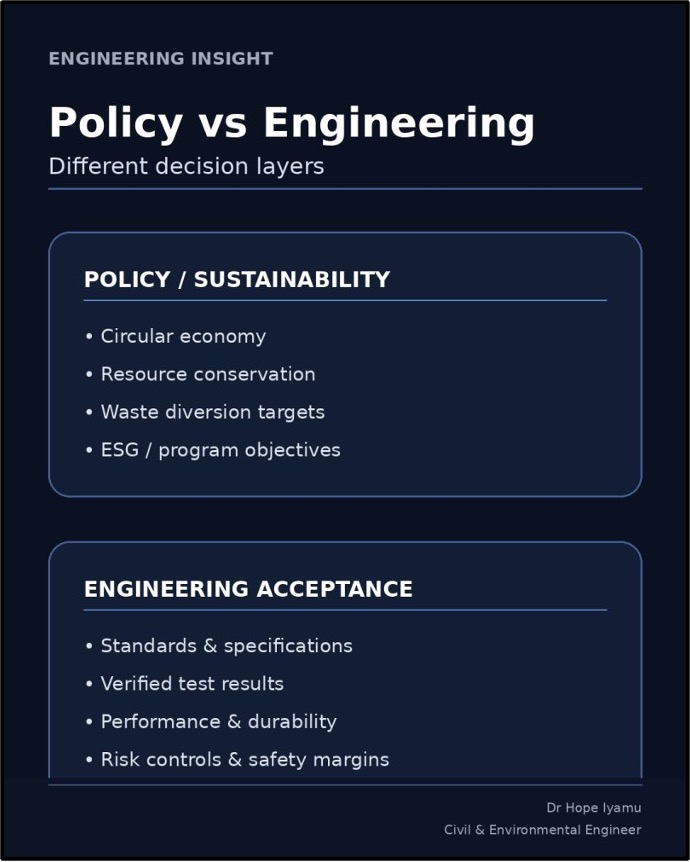
Policy/Sustainability focuses on:
- Circular economy
- Resource conservation
- Diversion targets
- ESG goals
Engineering acceptance focuses on:
- Standards & specifications
- Verified test results
- Durability & performance
- Risk controls & safety margins
Both matter, but they answer different questions.
Policy sets the direction.
Technical policy = design criteria/guidelines (useful and necessary)
Strategic/regulatory policy = high-level objectives/constraints (needs translation into engineering requirements)
Engineering decides what is technically acceptable.
That’s why a key principle still stands:
Origin, ideology, or perception should not override measurable performance.
Have you seen projects fail because policy arguments were treated like engineering evidence?
I’d love to hear real project examples (good or bad).
#EngineeringJudgement #Infrastructure #WaterEngineering #WasteManagement #CircularEconomy #PerformanceBasedDesign #RiskManagement #AssetManagement
About the Author
Dr Hope Iyamu is a Civil & Environmental Engineer, infrastructure and environmental leader, educator, and reflective author with more than two decades of experience across local government, major infrastructure, environmental governance, and strategic advisory. He writes on infrastructure, environmental governance, engineering leadership, regulatory compliance, and responsible development.
LinkedIn: www.linkedin.com/in/hope-iyamu