
By Dr Hope Iyamu | Civil & Environmental Engineer | Principal Consultant, HOPE Consultancy Services
Geographic Focus: Nigeria
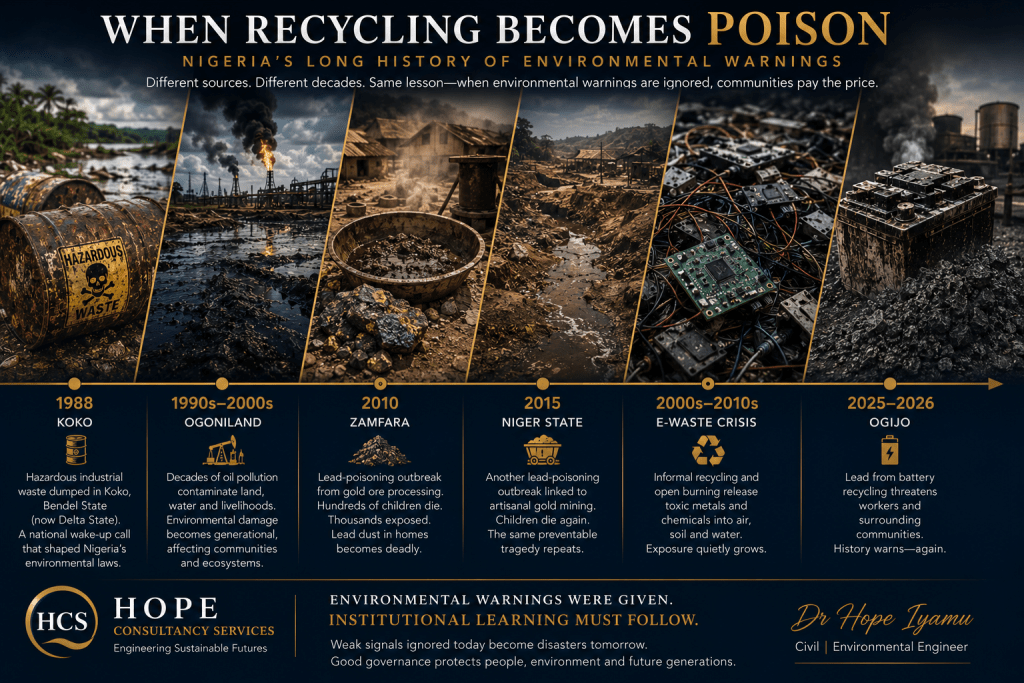
Nigeria's emerging battery-recycling crisis should concern every environmental regulator, industrial operator, public-health professional, and policymaker in the country.
Recent investigations into used lead-acid battery recycling activities in Ogijo, Ogun State, have raised serious concerns about lead exposure among workers and surrounding communities. Reports of contaminated soil, lead-bearing industrial dust, unsafe processing conditions, and elevated blood-lead levels are disturbing.
Lead is not an ordinary industrial contaminant.
It is a cumulative toxicant capable of affecting the brain, kidneys, cardiovascular system, and reproductive health. Children and developing fetuses are particularly vulnerable. During pregnancy, lead circulating in a mother's blood can cross the placenta and expose the developing child.
The situation in Ogijo is therefore not merely a recycling problem.
It is an environmental governance problem.
More importantly, it is not Nigeria's first warning.
From Koko to Ogoniland, from Zamfara to the growing e-waste economy and now Ogijo, Nigeria's environmental history reveals a troubling pattern.
The contaminants change.
The locations change.
The industries change.
But the institutional weaknesses are remarkably familiar.
1988: Koko and the Toxic Waste That Awakened a Nation
In 1988, Nigeria was confronted with one of the most infamous hazardous-waste incidents in African environmental history.
Thousands of containers, drums, and sacks of hazardous industrial waste originating from overseas had been stored in Koko, a small community in the then Bendel State, now Delta State.
The materials had reportedly been presented under misleading circumstances. By the time the nature of the waste became widely known, leaking containers and reports of adverse health effects had generated national and international outrage.
Koko became more than a contaminated site.
It became a symbol of environmental vulnerability.
The incident exposed a country without a sufficiently developed regulatory architecture to prevent, track, and respond to the transboundary movement of hazardous waste.
Nigeria responded.
The Harmful Waste (Special Criminal Provisions) Act was enacted in 1988, and the incident contributed significantly to the establishment of the Federal Environmental Protection Agency.
Internationally, the wider problem of hazardous waste being transferred to countries with weaker regulatory systems contributed to growing pressure for stronger transboundary waste controls, including the Basel Convention and, within Africa, the Bamako Convention.
Koko should have permanently changed Nigeria's environmental governance culture.
The lesson was simple:
"Where environmental controls are weak, vulnerable communities can become the final receptors of someone else's hazardous waste."
Unfortunately, the decades that followed suggest that Nigeria learned the legislative lesson more quickly than the institutional one.
The Niger Delta: When Pollution Becomes a Generational Condition
Nigeria's oil-producing communities provide another environmental warning.
Unlike Koko, which was a discrete hazardous-waste incident, pollution in parts of the Niger Delta developed through decades of repeated releases, damaged infrastructure, operational failures, illegal activities, and inadequate remediation.
Ogoniland became internationally synonymous with the environmental consequences of prolonged petroleum contamination.
The United Nations Environment Programme's environmental assessment documented extensive contamination of soil, groundwater, surface water, and ecosystems.
In some communities, drinking-water sources were found to contain petroleum-related contaminants at levels presenting serious public-health concerns.
The significance of Ogoniland extends beyond the oil industry.
It demonstrates an important environmental principle:
"Contamination that is ignored does not remain static."
It migrates.
It accumulates.
It enters environmental pathways.
It moves through soil, groundwater, surface water, food systems, and ecological receptors.
Eventually, an environmental compliance problem becomes a public-health problem.
And when contamination persists for decades, remediation becomes technically complex, financially demanding, and intergenerational.
Nigeria's experience in the Niger Delta should have reinforced the importance of early detection, competent regulation, transparent incident reporting, polluter accountability, and risk-based remediation. Yet another environmental disaster was already developing elsewhere.
2010: Zamfara and the Children Poisoned by Lead
In 2010, communities in Zamfara State experienced one of the most severe recorded childhood lead-poisoning outbreaks in modern history.
The source was associated with artisanal gold-ore processing.
Lead-rich ore was crushed and processed in and around residential compounds. Dust generated during the activity contaminated homes, soil, and areas where children lived and played.
The consequences were catastrophic.
Hundreds of children died.
Thousands of people were exposed.
What appeared to be a livelihood activity had created an environmental exposure pathway of extraordinary severity.
The Zamfara disaster demonstrated the importance of understanding the relationship between a contaminant source, its environmental pathway, and the human receptor.
In environmental risk assessment, the logic is straightforward:
Source → Pathway → Receptor.
In Zamfara, the source was lead-bearing ore.
The pathway included contaminated dust and soil.
The most vulnerable receptors were young children.
Once the complete exposure pathway existed, tragedy followed.
The response required environmental remediation, medical treatment, community education, and changes to ore-processing practices.
But Zamfara should also have triggered a broader national question:
How many hazardous livelihood and industrial activities are taking place across Nigeria without environmental-health surveillance?
2015: Niger State and a Warning Repeated
Five years after Zamfara, another lead-poisoning outbreak was reported in Niger State.
Again, artisanal gold mining and unsafe ore processing were implicated.
Children died.
The recurrence was particularly troubling because Nigeria had already witnessed Zamfara.
This was no longer an unknown hazard.
The contaminant was known.
The exposure pathway was understood.
The vulnerability of children was established.
Yet another community experienced a similar tragedy.
For environmental professionals, this raises a difficult governance question.
At what point does an environmental incident cease to be an unforeseen disaster and become a failure of institutional learning?
A mature regulatory system does not merely respond to incidents.
It learns from them.
It identifies comparable activities elsewhere.
It maps risk.
It inspects high-risk operations.
It develops sector guidance.
It monitors vulnerable communities.
And, where necessary, it intervenes before people die.
The 2000s and 2010s: Nigeria's Growing Electronic Waste Problem
As Nigeria's population, telecommunications sector, and appetite for electronic equipment expanded, another hazardous waste stream grew rapidly.
Electronic waste.
Computers, televisions, cables, circuit boards, mobile phones, and other electrical equipment contain valuable materials.
They can also contain lead, mercury, cadmium, brominated flame retardants, and other hazardous substances.
In a properly regulated resource-recovery system, these materials require controlled collection, dismantling, treatment, and downstream processing.
But where informal recycling dominates, cables may be burned to recover copper.
Electronic equipment may be manually broken apart.
Residual materials may be dumped.
Workers may handle hazardous components without appropriate respiratory protection, hygiene controls, or occupational-health monitoring.
The environmental consequence is predictable.
Heavy metals and persistent toxic substances can enter soil, dust, air, and water.
Again, the same environmental model appears:
Source → Pathway → Receptor.
And again, economically vulnerable workers and surrounding communities can carry the greatest risk.
Nigeria's e-waste challenge demonstrated that recycling is not automatically environmentally beneficial.
A recycling activity is only sustainable when the recovery process itself is properly controlled.
Otherwise, society simply converts one waste problem into another contamination problem.
2025–2026: Ogijo and the Lead Battery Recycling Warning
Now Nigeria is confronting serious concerns surrounding used lead-acid battery recycling in Ogijo, Ogun State.
Lead-acid batteries are highly recyclable. Indeed, lead recovery from used batteries can form an important part of a circular economy.
But there is a critical distinction between recycling and responsible recycling.
When batteries are manually broken, when lead-bearing materials are handled without adequate containment, when contaminated slag is poorly managed, when industrial dust migrates beyond site boundaries, and when workers operate without effective occupational controls, recycling can become a mechanism for distributing toxic contamination.
Investigations in Ogijo have reported disturbing levels of lead exposure among tested residents and workers, alongside evidence of contaminated soil and dust.
Nigeria's environmental regulator, NESREA, subsequently took enforcement action against several recycling facilities in the area over environmental concerns.
The health implications require careful scientific assessment.
It would be inappropriate to attribute every illness or congenital abnormality reported within a community directly to a recycling facility without epidemiological and medical evidence.
However, the known toxicology of lead is not in dispute.
Lead exposure can affect neurological development, reproductive health, kidney function, cardiovascular health, and multiple body systems. During pregnancy, maternal lead exposure can expose the developing fetus.
The question therefore should not be whether visible deformities can be photographed and attributed to a particular factory.
The more important regulatory question is:
Why should communities be exposed to preventable concentrations of a known developmental neurotoxin in the first place?
The Common Thread Is Not the Contaminant
Koko involved hazardous industrial waste.
Ogoniland involved petroleum contamination.
Zamfara and Niger State involved lead-bearing gold ore.
Nigeria's e-waste challenge involves multiple heavy metals and hazardous chemicals.
Ogijo involves lead from battery recycling.
Different industries.
Different contaminants.
Different decades.
But a familiar pattern emerges.
Weak environmental surveillance.
Inadequate baseline data.
Limited community exposure monitoring.
Poor industrial controls.
Informal or poorly controlled processing.
Delayed regulatory intervention.
Weak incident learning.
And, too often, action after communities have already been exposed.
Nigeria does not necessarily suffer from an absence of environmental legislation.
The greater challenge is often the distance between legislation and implementation.
A regulation that is not enforced does not protect groundwater.
An environmental permit that is not verified does not control emissions.
An environmental impact assessment that becomes a shelf document does not protect a community.
A monitoring requirement without credible data is simply an administrative exercise.
Environmental governance must ultimately be measured by outcomes.
Are emissions controlled?
Is contaminated water intercepted?
Are hazardous residues properly characterised and disposed of?
Are workers protected?
Are surrounding communities monitored?
Are environmental incidents detected early?
Can regulators demonstrate that risks are being reduced?
These are the questions that matter.
"Nigeria Must Move from Environmental Reaction to Environmental Intelligence"
The lesson from Koko to Ogijo is that Nigeria cannot continue to wait for visible tragedy before environmental risk becomes a national concern.
The country needs a more proactive environmental intelligence system.
High-risk industries and activities should be identified and mapped.
Used lead-acid battery recyclers, e-waste processors, artisanal mining areas, hazardous-waste facilities, petroleum-contaminated sites, and other high-risk operations should be subject to risk-based inspection and environmental-health surveillance.
Environmental monitoring must also extend beyond facility boundaries.
A factory may appear operationally compliant within its fence line while contaminated dust, groundwater, stormwater, or waste residues migrate into surrounding communities.
This is why modern environmental regulation must examine both the source and the receiving environment.
Nigeria also needs stronger integration between environmental regulation and public health.
Blood-lead surveillance should not begin only after children become visibly ill.
Groundwater testing should not begin only after communities complain about taste or colour.
Contaminated-site investigations should not begin only when a journalist publishes photographs.
Environmental governance must become anticipatory.
The country must learn to detect weak signals before they become national tragedies.
HCS Insight
"Environmental disasters rarely begin as disasters. They begin as unmanaged risks, weak signals, poor controls, and regulatory gaps that are allowed to persist."
From Koko to Ogijo, Nigeria's environmental history shows that the cost of delayed action is ultimately transferred to communities, ecosystems, public health, and future generations.
The most effective environmental regulation is not the regulation that responds loudly after contamination.
It is the governance system that identifies the risk, interrupts the pathway, and protects the receptor before irreversible harm occurs.
Nigeria has received enough environmental warnings.
The next stage must be institutional learning, competent enforcement, and prevention.
Further Reading
The following reports, regulatory publications and technical resources provide additional context on the environmental incidents, contamination pathways and public-health issues discussed in this article:
- United Nations Environment Programme (UNEP). Bamako Convention: Preventing Africa from Becoming a Dumping Ground for Toxic Wastes.
Provides historical context on the 1988 Koko hazardous-waste incident and Africa's subsequent response to the transboundary movement of hazardous waste. https://www.unep.org/news-and-stories/press-release/bamako-convention-preventing-africa-becoming-dumping-ground-toxic - United Nations Environment Programme (UNEP). Environmental Assessment of Ogoniland.
UNEP's major technical assessment of petroleum contamination in Ogoniland, including impacts on soil, groundwater, surface water, ecosystems and human health.
https://www.unep.org/resources/report/environmental-assessment-ogoniland - US Centers for Disease Control and Prevention (CDC). Lead Poisoning Investigation in Northern Nigeria.
Examines the 2010 Zamfara lead-poisoning outbreak associated with artisanal gold-ore processing and the environmental exposure pathways affecting children.
https://www.cdc.gov/one-health/php/stories/lead-poisoning.html - Policy and Legal Advocacy Centre (PLAC). Senate Calls on Federal Government to Take Action on the High Incidence of Lead Poisoning in Niger State.
Provides background on the 2015 Shikira community lead-poisoning outbreak in Niger State, in which 28 children were reported to have died.
https://placng.org/i/senate-calls-on-fg-to-take-action-on-the-high-incidence-of-lead-poisoning-in-niger-state/ - United Nations Environment Programme (UNEP). Nigeria Turns the Tide on Electronic Waste.
Discusses Nigeria's informal e-waste economy, hazardous material releases and the environmental and human-health risks associated with uncontrolled electronics processing.
https://www.unep.org/news-and-stories/press-release/nigeria-turns-tide-electronic-waste - National Environmental Standards and Regulations Enforcement Agency (NESREA). Enforcement Action Against Recycling Facilities in South-West Nigeria.
Details regulatory concerns regarding battery and scrap-metal recycling activities, hazardous lead-bearing slag and evidence of lead exposure among residents in Ogijo.
https://nesrea.gov.ng/2025/11/28/nesrea-ogun-state-govt-seal-recycling-facilities-in-ogijo/ - World Health Organization (WHO). Lead Poisoning and Health.
Summarises the toxicological and public-health effects of lead exposure, including impacts on children's neurological development and risks during pregnancy.
https://www.who.int/news-room/fact-sheets/detail/lead-poisoning-and-health - Federal Ministry of Health and Social Welfare, Nigeria. National Policy and Action Plan on Lead Poisoning Elimination 2024.
Nigeria's national policy framework addressing lead exposure, surveillance, prevention and cross-sectoral action. The policy identifies lead as a cumulative toxicant affecting multiple body systems and recognises neurological, kidney and reproductive effects.
https://health.gov.ng/wp-content/uploads/2025/11/NATIONAL-POLICY-AND-ACTION-PLAN-ON-LEAD-POISONING-ELIMINATION-2024.pdf
About the Author
Dr Hope Iyamu is a Civil & Environmental Engineer, infrastructure advisor, educator, and Principal Consultant at HOPE Consultancy Services. With more than two decades of international experience across infrastructure, environmental governance, waste and wastewater management, regulatory compliance, sustainability, and strategic advisory, he works with government and industry to deliver practical, evidence-based solutions.
Through HCS Insights, he shares professional perspectives on environmental governance, infrastructure performance, regulatory compliance, sustainability, and the systems required to support better public and organisational decision-making.