
Environmental regulation is often viewed as a constraint on development.
In reality, it is one of the foundations of responsible development.
Environmental regulation provides the governance framework through which economic development can proceed while environmental risks are properly identified, assessed and managed.
In Western Australia, the resources sector operates within a structured environmental governance framework under the Environmental Protection Act 1986, supported by the Department of Water and Environmental Regulation (DWER) and the Environmental Protection Authority (EPA).
Together, these institutions provide the regulatory architecture that ensures development proceeds within acceptable environmental limits while maintaining environmental accountability.
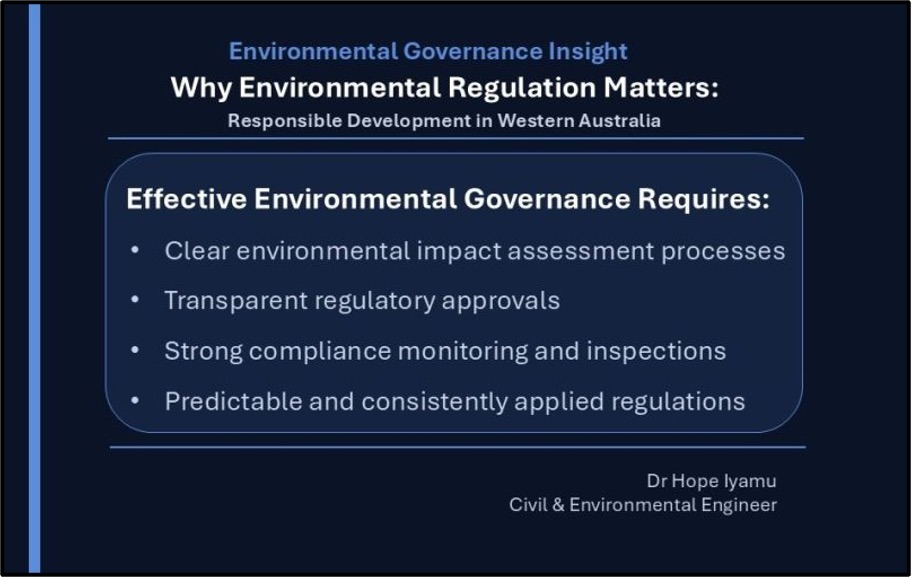
Key mechanisms such as environmental impact assessment, statutory approvals, monitoring and compliance inspections, form the operational backbone of this regulatory system. Their purpose is straightforward: identify environmental risks early, set clear conditions for development, and ensure operators remain accountable throughout the life of a project.
However, environmental regulation is most effective when it is predictable, transparent and consistently applied.
When regulatory frameworks are clear and stable, industry can plan investments with confidence, regulators can enforce standards effectively, and communities can trust that environmental safeguards are being upheld.
Conversely, regulatory uncertainty can create challenges for both industry and government. Approval processes may become prolonged, stakeholder confidence may weaken, and investment decisions may become more complex.
At the same time, weak oversight carries its own risks, including environmental harm, reputational damage, and erosion of public trust.
Striking the right balance between regulatory rigour and practical implementation is therefore essential.
Strong environmental regulation should not be viewed as a barrier to development, but rather as a foundation for responsible and sustainable growth.
Well-designed regulatory frameworks ultimately protect ecosystems, support investor certainty, and maintain community confidence in the long-term management of Western Australia's natural resources.
Interested to hear perspectives from regulators, environmental approvals specialists, asset owners, and project engineers working across Western Australia’s resources and infrastructure sectors.
#EnvironmentalGovernance #EnvironmentalRegulation #WesternAustralia #ResourcesSector #EnvironmentalApprovals#InfrastructureDevelopment #SustainableDevelopment
About the Author
Dr Hope Iyamu is a Civil & Environmental Engineer, infrastructure and environmental leader, educator, and reflective author with more than two decades of experience across local government, major infrastructure, environmental governance, and strategic advisory. He writes on infrastructure, environmental governance, engineering leadership, regulatory compliance, and responsible development.
LinkedIn: www.linkedin.com/in/hope-iyamu